Choosing the right stud finder can make wall mounting, remodeling, and shelving projects faster and safer. The best electronic stud finders do more than locate framing: many also detect metal and warn you about live AC wiring.
This roundup compares 10 options across sensor coverage, detection depth, controls, alerts, and overall value, so you can match a scanner to your project and experience level.
Best 10 Electronic Stud Finders Picks for 2026
Most Versatile
Franklin Sensors ProSensor M210

- 13 sensors show full stud width
- No calibration required
- Detects studs up to 1.7 inches deep
Best For: DIYers needing deep, broad scans and live-wire detection
Best Simple Edge Finder

- Finds wood and metal stud edges
- Works through wallpaper and fabric
- Shock- and water-resistant body
Best For: Basic stud-edge locating on covered walls
Best Multi-Mode Scanner

- Three scanning modes for varied tasks
- Detects metal and hot electrical wires
- LCD, audio, and SpotLite guidance
Best For: Users wanting flexible, guided wall scanning
Best Compact Option
Franklin Sensors ProSensor M90

- Nine sensors show full stud width
- No calibration required
- Compact design with 1.5-inch depth
Best For: Home users wanting simple, portable scanning
Wire-Aware Scanning

- Detects wood and metal stud edges
- DeepScan reaches up to 1 1/2 inches
- Alerts to hot wires up to 2 inches deep
Best For: DIY mounting projects requiring stud-edge and live-wire detection
Calibration-Free Coverage
Franklin Sensors ProSensor M70

- Uses seven sensors for scanning
- Needs no calibration before use
- Shows full stud width and center
Best For: Fast wood and metal stud detection with broad LED guidance
Guided Center Finding

- Locates stud centers up to 3/4 inch deep
- Uses arrows and audible alerts
- Includes AAA batteries and auto-calibrates
Best For: Routine wood or metal framing searches on compatible wall surfaces
Most Comprehensive Coverage
Franklin Sensors ProSensor M150

- Nine sensors display stud width and centers
- No calibration required
- Deep scanning and live-wire detection
Best For: DIYers who want simple, full-width stud detection
Best Mode Flexibility

- Four dedicated detection modes
- LCD graphics with audio alerts
- Battery and carrying pouch included
Best For: Homeowners scanning single-layer drywall
Best Display and Grip
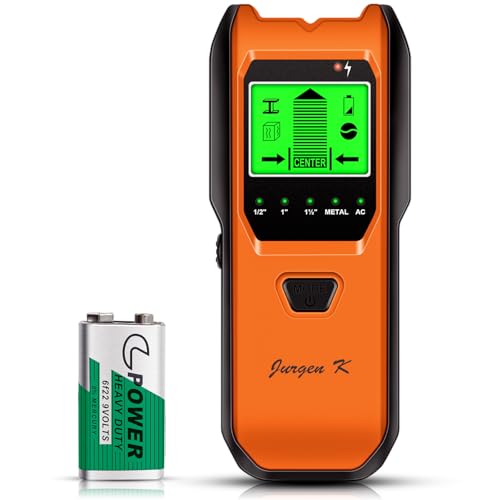
- Three stud-depth settings plus metal and AC modes
- Backlit LCD with audio alarm
- Ergonomic grip and included 9V battery
Best For: DIYers who want adjustable scanning and clear feedback
Most Versatile – Franklin Sensors ProSensor M210
Among electronic stud finders, the Franklin Sensors ProSensor M210 stands out for its 13-sensor design, which displays the full width of wood or metal studs instead of only locating individual fasteners. It requires no calibration and scans up to 1.7 inches deep.
Best For: DIYers who want broad stud visibility, deep scanning, and added live-wire detection.
Pros:
- 13 sensors and a display showing the full stud width
- No calibration required; begin scanning anywhere
- Detects wood and metal studs up to 1.7 inches deep
- Includes live-wire detection, bubble level, and pencil caddy
Cons:
- Requires two AA batteries, which are not included
- Larger and heavier than the compact M90
The M210 is a strong all-purpose choice when accurate stud-center marking and deeper detection matter. Its extra features make it useful for mounting and drilling projects, though buyers should supply two AA batteries.
Best Simple Edge Finder – CRAFTSMAN CMHT77633
For shoppers comparing electronic stud finders for routine wall work, the CRAFTSMAN CMHT77633 offers straightforward edge detection through up to 3/4 inch of drywall. It also works on wallpaper and fabric-covered surfaces.
Best For: Basic stud-edge locating on finished walls and covered surfaces.
Pros:
- Locates edges of wood and metal studs
- Works through wallpaper and fabric
- Shock-resistant and water-resistant body
- Includes a full lifetime warranty
Cons:
- Detection depth is limited to 3/4 inch through drywall
- Notes do not indicate live-wire detection or a center-finding display
The CRAFTSMAN is a practical pick for uncomplicated projects where identifying stud edges is enough. Its durable body and lifetime warranty add reassurance, but it lacks the deeper and more feature-rich scanning described for the other options.
Best Multi-Mode Scanner – Zircon MultiScanner A200
The Zircon MultiScanner A200 gives electronic stud finders added flexibility with StudScan, DeepScan, and Metal Scan modes. It can locate wood and metal stud edges and centers, scan up to 1.5 inches deep in DeepScan mode, and warn about hot wires.
Best For: DIYers and professionals who want multiple detection modes and clear visual guidance before drilling.
Pros:
- StudScan finds edges and centers up to 3/4 inch deep
- DeepScan reaches up to 1.5 inches
- Metal Scan and WireWarning add drilling awareness
- LCD display, audio tone, and SpotLite Pointer support marking
Cons:
- Requires careful calibration before scanning
- Uses a 9V alkaline battery, not included in the supplied notes
The A200 is the most mode-focused option in this group. Its calibration process requires attention, but the combination of stud, metal, deep-scan, and live-wire functions makes it well suited to varied wall-scanning tasks.
Best Compact Option – Franklin Sensors ProSensor M90
The Franklin Sensors ProSensor M90 is a compact choice among electronic stud finders, using nine sensors to show the full width of wood or metal studs. Its no-calibration operation and always-on deep scan reach up to 1.5 inches.
Best For: Home users who want a small, simple scanner with full-width stud visibility.
Pros:
- Nine sensors improve full-width stud detection
- No calibration required before scanning
- Detects wood and metal studs up to 1.5 inches deep
- Compact 5.38-inch design and low 5.12-ounce weight
Cons:
- Requires two AAA batteries, which are not included
- Not compatible with rechargeable batteries
- Notes do not list live-wire detection
The M90 balances useful depth and full-width visibility in a smaller body than the M210. It is a convenient everyday option for mounting projects, provided you are comfortable using disposable AAA batteries.
Wire-Aware Scanning – Zircon StudSensor A100
For DIYers comparing electronic stud finders, the Zircon StudSensor A100 combines edge-finding with live-wire alerts. It offers standard and deeper scanning modes, plus visual and audio guidance for marking wall locations.
Best For: Home projects involving shelves, mirrors, cabinets, or TVs where stud edges and possible live wires need to be identified.
Pros:
- Finds wood and metal stud edges up to 3/4 inch in StudScan mode.
- DeepScan mode reaches up to 1 1/2 inches through thicker surfaces.
- WireWarning Detection continuously alerts to hot, unshielded wires up to 2 inches deep.
- LCD screen, audio tone, SpotLite Pointer, and V marker groove support marking.
Cons:
- Requires careful flat-wall calibration before scanning.
- Uses a 9V alkaline battery, which is not included in the supplied notes.
The A100 is a practical choice when electrical-wire awareness matters alongside stud locating. Its calibration step requires attention, but the combination of depth modes and marking aids is useful for common mounting tasks.
Calibration-Free Coverage – Franklin Sensors ProSensor M70
The Franklin Sensors ProSensor M70 stands out among electronic stud finders with seven sensors and a full-width LED display. Its no-calibration operation is designed for quick scanning over drywall, including directly over a stud.
Best For: Users who want simple, broad stud detection for wood and metal framing without a separate calibration step.
Pros:
- Seven sensors are designed to improve detection accuracy.
- Requires no calibration and can start scanning anywhere.
- LEDs show the full width of a stud, with a green center indicator.
- Deep scanning up to 1.5 inches finds wood and metal studs.
Cons:
- Two AAA batteries are required and are not included.
- Not compatible with rechargeable batteries.
The M70 focuses on straightforward operation and broad visual feedback rather than multiple scan modes. It is a strong fit for shoppers who value no-calibration use and a clear indication of stud width and center.
Guided Center Finding – DEWALT DW0100 Stud Finder
The DEWALT DW0100 is a slim electronic stud finder for locating wood and metal framing to a depth of 3/4 inch. Center-find technology, directional LED arrows, and auto-calibration help guide users toward a stud center.
Best For: Everyday wall-mounting tasks where a compact scanner with center marking, audible alerts, and included AAA batteries is useful.
Pros:
- Center-find technology helps locate the stud center.
- Detects wood and metal studs up to 3/4 inch deep.
- Provides AC and live-wire detection for added safety.
- Includes AAA batteries and uses constant auto-calibration.
Cons:
- Does not detect objects in concrete, mortar, block, brick, plaster, carpeting, foil-faced materials, metallic surfaces, or ceramic tile.
- Is not designed to locate non-ferrous or plastic objects such as pipes.
- Its stated detection depth is limited to 3/4 inch.
The DW0100 keeps the scanning process approachable with automatic calibration and directional feedback. Its material limitations make it best suited to compatible wall surfaces and standard, relatively shallow framing searches.
Most Comprehensive Coverage – Franklin Sensors ProSensor M150
Among electronic stud finders, the Franklin Sensors ProSensor M150 stands out for its nine-sensor design and no-calibration operation. It displays the full width of detected studs, identifies centers, and includes deep scanning plus live-wire detection.
Best For: DIYers who want broad stud coverage and simple scanning on drywall.
Pros:
- Nine sensors help show stud width, double studs, and centers.
- No calibration is required before scanning.
- Detects wood and metal studs up to 1.5 inches deep.
- Includes live-wire detection for added drilling awareness.
Cons:
- Two AAA batteries are required but not included.
- Not compatible with rechargeable batteries.
The M150 is a practical choice when you prefer a straightforward scanner that shows more than a single point. Its always-on deep scan and full-width LED display make it especially useful for planning where to drill.
Best Mode Flexibility – Mecurate 5-in-1 Wall Scanner
The Mecurate is one of the more versatile electronic stud finders for drywall projects, with dedicated modes for standard, deep, metal, and AC detection. Its LCD graphics and audio alerts provide clear feedback while scanning.
Best For: Homeowners who want multiple detection modes and included accessories for routine drywall work.
Pros:
- Offers standard, deep, metal, and AC scanning modes.
- LCD graphics and audio alerts make readings easy to follow.
- Detects studs up to 1.5 inches, metal up to 2-3/8 inches, and AC up to 2 inches.
- Includes a 9V battery, carrying pouch, and user manual.
Cons:
- Requires calibration against the wall before each use.
- Performance is best on single-layer drywall.
- Not recommended for concrete, brick, tile, or other non-drywall surfaces.
This scanner offers useful flexibility for homeowners handling different wall-detection tasks. Follow the calibration and surface guidance in the manual for the most consistent results.
Best Display and Grip – Jurgen K 5-in-1 Stud Scanner
The Jurgen K is a multifunction option among electronic stud finders, combining three stud-depth settings with metal and AC modes. Its backlit LCD, continuous audio alarm, ergonomic grip, and included 9V battery are geared toward convenient scanning.
Best For: DIY enthusiasts and homeowners who want adjustable depth settings and an easy-to-read display.
Pros:
- Provides 1/2-inch, 1-inch, 1.5-inch, metal, and AC scan modes.
- Backlit LCD shows detected material and position.
- Ergonomic non-slip grip supports comfortable scanning.
- Includes a 9V battery and low-power indicator.
Cons:
- Calibration is required before use.
- Battery cell type is listed as other than specified.
- The supplied notes do not specify a carrying case or additional accessories.
With adjustable scan depths and detection for metal and live AC wires, the Jurgen K is suited to varied household installation jobs. Its display and audible alerts help make the scanning process easier to monitor.
How We Picked the Best Electronic Stud Finders
We focused on scanners that provide useful wall-detection capabilities for common home improvement tasks. Our comparison considers sensor design, advertised scanning depth, wood and metal detection, live-wire warnings, display or LED guidance, operating simplicity, and power requirements.
Because wall materials and installation conditions vary, no stud finder can guarantee perfect results in every situation. The strongest choices make scanning easier to repeat and provide clear feedback when a target or potential hazard is nearby.
Quick Comparison
The Franklin Sensors models emphasize broad sensor coverage, which can make stud edges and centers easier to identify. CRAFTSMAN and DEWALT offer straightforward 3/4-inch scanning for basic framing projects. Zircon models add established multi-purpose detection for studs, metal, and live wires.
The Mecurate and multifunction LCD scanner are appealing when you want several detection modes and visual or audio alerts in one tool. Before buying, check the listed model features carefully: sensor count, detection modes, display style, and depth claims differ considerably.
Key Buying Factors for Electronic Stud Finders
Detection Targets
For hanging cabinets or heavy shelves, wood-stud detection is the priority. If you work around plumbing, metal framing, or masonry, choose a model with metal detection. Live-AC warning capability is a valuable safety feature, but it should never replace turning off power and following safe drilling practices.
Accuracy and Scanning Coverage
Multi-sensor designs can cover more wall area at once and may help identify a stud center without repeated passes. A conventional single-sensor scanner can still work well, but it generally requires slower, more careful edge-to-edge scanning and calibration.
Feedback and Controls
LED arrows, LCD graphics, audible alarms, and center or edge indicators each suit different users. A simple light-and-beep interface is quick for occasional repairs, while a display can provide more information when detecting multiple material types.
Depth, Calibration, and Power
Compare the advertised depth with your wall construction, especially if you are scanning through thick drywall, tile, or paneling. Automatic calibration may reduce setup, but keeping the tool flat and moving it steadily remains essential. Also check whether batteries are included and which size the scanner uses.
Who Should Buy Which Electronic Stud Finders?
Choose a Franklin Sensors ProSensor model if broad sensor coverage and quick stud locating are your main priorities. The M210 is the most feature-rich option in this group, while the M70 and M90 suit shoppers seeking a simpler or more affordable approach.
Select a Zircon scanner if metal and live-wire detection are central to your projects. The CRAFTSMAN or DEWALT is a practical fit for basic wood-framing tasks and shoppers who prefer familiar, uncomplicated controls. Pick the Mecurate or LCD multifunction scanner if you want multiple detection modes, screen feedback, and audio alerts in a single tool.