Finding a stud before drilling helps protect your walls, fasteners, and electrical wiring. The best stud finders for home use make that task easier, whether you are hanging a shelf, mounting a television, or installing cabinets.
This roundup compares magnetic locators, electronic scanners, and multifunction wall detectors so you can choose the right balance of simplicity, depth, accuracy, and safety features for your projects.
Best 10 Stud Finders for Home Use Picks for 2026
Most Comprehensive Scan
Franklin Sensors ProSensor M210

- 13 sensors show full stud width and center
- Scans wood and metal studs up to 1.7 inches deep
- Adds live-wire detection and a bubble level
Best For: Homeowners wanting detailed electronic wall scanning
Best Battery-Free Pick
CH Hanson Magnetic Stud Finder

- Rare-earth magnets locate nails and screws
- No batteries, charging, or calibration required
- Rotating level helps with horizontal and vertical marks
Best For: Simple mounting and leveling tasks
Best Multi-Mode Scanner

- Offers StudScan, DeepScan, and Metal Scan modes
- Detects studs, metal, and potential live AC wires
- Uses LCD, audio, and SpotLite marking guidance
Best For: Versatile drilling checks around the home
Simplest Magnetic Option

- Neodymium magnets locate drywall fasteners
- Needs no batteries or calibration
- Made for standard drywall and wood construction
Best For: Quick, basic stud locating on drywall
Versatile Wall Scanning
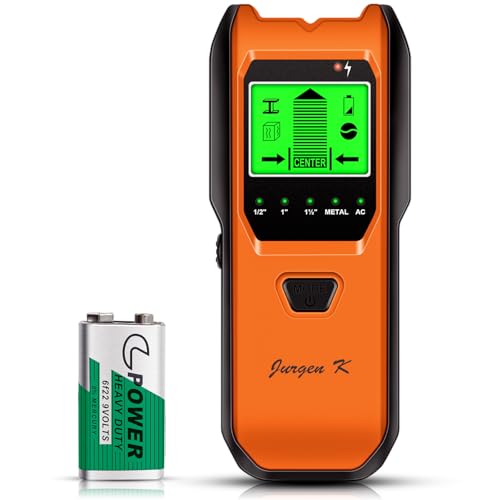
- Five scanning modes cover studs, metal, AC wires, and more.
- LCD display and audio alarm help identify detected materials.
- Auto-calibration, ergonomic grip, and included 9V battery.
Best For: DIYers who want one scanner for varied wall, floor, and ceiling projects
Simple Everyday Detection
CRAFTSMAN 3/4-Inch Stud Finder

- Locates wood and metal stud edges through drywall.
- Works over wallpaper and fabric-covered surfaces.
- Shock-resistant, water-resistant body with lifetime warranty.
Best For: Basic wall-hanging projects where stud-edge detection is enough
Wide-Stud Visualization
Franklin Sensors ProSensor M150

- Nine sensors detect full stud width and centers.
- No calibration required; deep scan reaches up to 1.5 inches.
- Includes live-wire warning and wood/metal stud detection.
Best For: Users who want fast, visual full-width stud readings
Best with Extra Features

- Five detection modes for studs, metal, and AC wires
- LCD graphics and audio alerts simplify scanning
- Best suited to calibrated use on single-layer drywall
Best For: DIYers handling routine drywall projects
Rechargeable Multi-Surface Scanning
FNIRSI WD-01 6-in-1 Wall Scanner

- Six modes cover studs, metals, copper, and AC wires
- Positioning hole helps mark detected edges and centers
- Rechargeable design with automatic calibration
Best For: Users wanting versatile scanning for walls, floors, and ceilings
Simple Center Finding
DEWALT DW0100 3/4-Inch Stud Finder

- Center-find technology targets wood and metal studs
- Auto-calibration, LED arrows, and audible alerts aid use
- Slim design with included AAA batteries
Best For: Basic shallow stud-location tasks
Most Comprehensive Scan – Franklin Sensors ProSensor M210
For shoppers comparing stud finders for home use, the Franklin Sensors ProSensor M210 is designed for broad, straightforward wall scanning. Its 13 sensors display the full width of wood or metal studs, while deep scanning and live-wire detection add useful guidance before drilling.
Best For: Homeowners who want full-width stud detection, deep scanning, and extra safety features for mounting or wall projects.
Pros:
- Thirteen sensors help show stud width and centers.
- No calibration is required before scanning.
- Detects wood and metal studs up to 1.7 inches deep.
- Includes live-wire detection, a bubble level, and pencil caddy.
Cons:
- Requires two AA batteries, which are not included.
- Its electronic design may be more than needed for simple screw-location tasks.
The M210 is a feature-rich choice when you want more information than a basic magnetic locator provides. Its full-width LED display and always-on deep scan make it particularly practical for varied home projects.
Best Battery-Free Pick – CH Hanson Magnetic Stud Finder
If you prefer simple stud finders for home use, the CH Hanson Magnetic Stud Finder uses rare-earth magnets to locate nails and screws behind drywall, plaster, and paneling. It needs no batteries or calibration and includes a rotating level for marking installation lines.
Best For: DIYers who want a compact, maintenance-free tool for locating magnetic fasteners and leveling shelves, TVs, or other fixtures.
Pros:
- Requires no batteries, charging, or calibration.
- Rare-earth magnets help locate nails and screws behind wall coverings.
- Built-in rotating level supports horizontal and vertical marking.
- Lightweight, pocket-sized design weighs 0.15 pounds.
Cons:
- It locates nails and screws rather than displaying the full width of a stud.
- It does not provide electronic live-wire detection.
This is a practical choice for straightforward mounting jobs where finding fasteners is sufficient. The battery-free design keeps it ready whenever you need a quick wall check.
Best Multi-Mode Scanner – Zircon MultiScanner A200
The Zircon MultiScanner A200 gives shoppers seeking stud finders for home use several scanning options in one device. StudScan, DeepScan, and Metal Scan modes help locate wood or metal studs, metal objects, and potential live AC wires before drilling.
Best For: Homeowners and DIYers who want selectable scan modes, visual marking guidance, and alerts for metal and live wiring.
Pros:
- StudScan detects stud edges and centers up to 3/4 inch deep.
- DeepScan reaches up to 1 1/2 inches, while Metal Scan locates metal.
- LCD display, audio tone, and SpotLite Pointer support marking.
- WireWarning Detection alerts users to hot electrical wires.
Cons:
- Requires careful calibration against the wall before scanning.
- Needs a 9V alkaline battery, which must be replaced when low.
The A200 suits projects where wall conditions and detection needs vary. Its multiple modes offer useful flexibility, provided you follow the calibration steps and scan slowly.
Simplest Magnetic Option – The Original StudBuddy
For uncomplicated stud finders for home use, The Original StudBuddy uses encapsulated neodymium magnets to find screw and nail heads in drywall. When it detects a fastener, the tool sticks to the wall, providing a simple visual location without batteries or calibration.
Best For: Homeowners who need an inexpensive, easy-to-use magnetic locator for standard drywall and wood construction.
Pros:
- No batteries, moving parts, or calibration are required.
- Powerful magnets locate fasteners in drywall.
- It sticks to the wall at detected screw or nail locations.
- Made in the USA from durable materials.
Cons:
- Not intended for lath-and-plaster walls.
- Finds screw or nail locations rather than the entire stud width.
- Does not include electronic depth or live-wire detection.
The StudBuddy is a good fit for quick drywall checks when simplicity matters more than advanced scanning features. Its limitations make it less suitable for lath-and-plaster or safety-focused electrical work.
Versatile Wall Scanning – 5-in-1 Smart Stud Finder
For shoppers comparing stud finders for home use, this 5-in-1 wall scanner offers several detection modes for common projects. It is designed to locate wood and metal studs, live AC wires, pipes, and other hidden materials, with an LCD display and audio alerts to guide scanning.
Best For: Homeowners and DIY users handling picture hanging, TV installation, shelving, or renovation work.
Pros:
- Offers stud, metal, and AC scanning modes with multiple depth settings.
- LCD display shows detected material and position, while audio alerts provide additional feedback.
- Includes auto-calibration, an ergonomic non-slip grip, and a backlit screen.
- Comes with a 9V battery and includes a low-power indicator.
Cons:
- Requires calibration before use for the stated accuracy and reliability.
- The broad range of detection modes may require learning which setting fits each project.
This is a feature-rich choice when you want more than basic stud detection. Its combination of depth modes, material scanning, display guidance, and wire detection makes it particularly useful for varied home projects.
Simple Everyday Detection – CRAFTSMAN 3/4-Inch Stud Finder
If you want straightforward stud finders for home use, the CRAFTSMAN CMHT77633 focuses on locating stud edges through drywall. Its 3/4-inch detection depth and ability to work over wallpaper and fabric make it a practical option for routine wall-hanging tasks.
Best For: Homeowners who need a simple tool for locating wood or metal stud edges behind finished wall surfaces.
Pros:
- Detects stud edges through drywall to a depth of 3/4 inch.
- Works on surfaces covered with wallpaper and fabric.
- Shock-resistant and water-resistant body supports everyday durability.
- Includes a full lifetime warranty.
Cons:
- Has a shallower stated detection depth than the other scanners in this roundup.
- Focuses on stud-edge detection rather than offering listed metal, pipe, or AC-wire scanning modes.
The CRAFTSMAN is best suited to uncomplicated wall projects where edge location is the main goal. Its durable body and surface compatibility add convenience, but shoppers needing deeper or multi-material scanning may prefer a more advanced model.
Wide-Stud Visualization – Franklin Sensors ProSensor M150
Among stud finders for home use, the Franklin Sensors ProSensor M150 stands out for its nine-sensor layout and no-calibration operation. It displays the full width of detected studs, identifies centers with a green LED, and includes deep scanning plus live-wire warning.
Best For: DIYers who want quick scanning with full-width stud visualization and an always-on deep-scan mode.
Pros:
- Nine sensors are designed to improve accuracy compared with conventional one- or two-sensor finders.
- Requires no calibration and can begin scanning anywhere, including over a stud.
- LED display shows full-width and double studs, with the center indicated in green.
- Detects wood and metal studs up to 1.5 inches deep and includes live-wire detection.
Cons:
- Two AAA batteries are required but are not included.
- It is not compatible with rechargeable batteries.
This model is a strong fit for users who prefer visual feedback over a single point reading. Its no-calibration design and full-width display simplify scanning, while the deep-scan and wire-warning features add utility for drilling and mounting tasks.
Best with Extra Features – Mecurate 5-in-1 Stud Finder
For homeowners comparing stud finders for home use, the Mecurate 5-in-1 offers dedicated modes for studs, deeper targets, metal, and live AC wires. Its LCD graphics, audio alerts, and included 9V battery make it approachable for routine drywall projects, though calibration and surface limitations are important to note.
Best For: DIYers scanning single-layer drywall for studs, metal, and live AC wires.
Pros:
- Five modes cover standard studs, deep scanning, metal, and AC detection.
- Bright LCD screen provides real-time detection information with clear graphics.
- Live-wire alerts add a useful safety check before drilling.
- Includes a battery, carrying pouch, and user manual.
Cons:
- Works best on single-layer drywall and is not recommended for concrete, brick, tile, or similar surfaces.
- Requires calibration against the wall before each use for best accuracy.
The Mecurate is a feature-rich choice for common drywall tasks, especially when you want both stud location and basic hazard detection in one tool. Follow the manual’s calibration and scanning guidance to get the most consistent results.
Rechargeable Multi-Surface Scanning – FNIRSI WD-01 6-in-1 Wall Scanner
The FNIRSI WD-01 stands out among stud finders for home use with six detection modes, automatic calibration, and a rechargeable design. It can identify stud edges and centers along with several metal, copper-wire, and live-AC targets, while its positioning hole helps mark locations directly.
Best For: Home users who want broad detection options and rechargeable operation across several listed wall and flooring surfaces.
Pros:
- Six modes detect wood and metal studs, ferrous and non-ferrous metal, AC wires, and copper wires.
- Positioning hole helps mark the edges and center of detected objects.
- Automatic calibration and an LCD with audio alarm support straightforward scanning.
- Rechargeable battery avoids routine battery replacement.
Cons:
- Detection depth varies substantially by mode and target type.
- Live AC detection is specified for unshielded wires, so it should not be treated as universal wire detection.
Choose the WD-01 if flexibility is more important than a basic stud-only design. Its combination of marking assistance, multiple detection modes, and rechargeable power is useful for varied household projects, provided you stay within the stated detection limits.
Simple Center Finding – DEWALT DW0100 3/4-Inch Stud Finder
For straightforward stud finders for home use, the DEWALT DW0100 focuses on locating wood and metal framing studs up to 3/4 inch deep. Center-find technology, constant auto-calibration, LED arrows, an audible alert, and a center-marking channel make it a practical option for basic fastening tasks.
Best For: Homeowners who primarily need to locate shallow wood or metal framing studs.
Pros:
- Center-find technology helps identify the stud center.
- Constant auto-calibration saves time during use.
- LED arrows and an audible alert provide visual and sound guidance.
- Slim profile and included AAA batteries support convenient storage and setup.
Cons:
- Detection depth is limited to 3/4 inch for wood and metal.
- Not designed for concrete, brick, plaster, tile, metallic surfaces, or non-ferrous and plastic objects.
- It offers fewer scanning modes than the other products in this roundup.
The DW0100 is best when you want a compact, uncomplicated tool for common stud-location jobs. Its narrow focus can be an advantage for basic projects, but users needing deeper or broader material detection should consider a more versatile scanner.
How We Picked the Best Stud Finders for Home Use
We focused on tools suited to common household jobs, including hanging shelves, securing televisions, mounting artwork, and locating framing behind drywall. Our comparison considers detection method, scanning depth, stud-centering capability, live-wire warnings, display and audio feedback, power requirements, and ease of calibration.
Magnetic models are included for shoppers who want a battery-free, low-maintenance option. Electronic scanners offer more information and can detect wood or metal framing, electrical wiring, and sometimes pipes or other materials. Because wall construction varies, no stud finder should be treated as a substitute for careful drilling practices or knowledge of a room’s wiring and plumbing layout.
Quick Comparison
| Type | Best for | Main advantage | Potential limitation |
|---|---|---|---|
| Magnetic | Simple drywall projects | No batteries and minimal setup | Locates fasteners rather than the full stud |
| Electronic | General home improvement | Can identify stud edges, centers, and warnings | Needs calibration and batteries |
| Multifunction scanner | Complex walls and renovations | Multiple detection modes and displays | More settings and possible false readings |
Key Buying Factors for Stud Finders for Home Use
Detection Method and Depth
Magnetic finders are straightforward when drywall fasteners align with the framing. Electronic models are generally more useful when you need to locate the stud’s edges or center. Check the advertised depth, but remember that plaster, tile, thick paint, insulation, and double-layer drywall can reduce performance.
Live-Wire Detection
An AC-wire warning is a valuable safety feature, especially when drilling near outlets, switches, and light fixtures. Treat it as an alert rather than a guarantee: scan slowly, follow the manufacturer’s instructions, and turn off power before drilling whenever practical.
Center Finding and Feedback
LED arrows, sound alerts, LCD screens, and center indicators can make placement easier. A center-finding mode is particularly useful for shelves and wall mounts, while a simple magnet may be enough for occasional picture hanging.
Power and Usability
Battery-free tools are convenient for quick jobs. Electronic and rechargeable scanners may provide more functionality but require charging, spare batteries, or calibration on a clear section of wall. A comfortable grip and clear controls matter when scanning large areas.
Who Should Buy Which Stud Finders for Home Use?
Choose a magnetic model if you want the simplest solution for light-duty drywall work and do not need electronic warnings. Pick a basic electronic stud finder for routine mounting projects where locating edges and centers is more important than advanced material detection.
A multi-sensor or multifunction wall scanner is a better fit for remodelers, homeowners working across different wall surfaces, or anyone who wants metal and live-wire detection in one tool. For frequent mounting of heavy shelves, cabinets, or televisions, prioritize reliable center detection, suitable scanning depth, and a clear wire-warning system over extra modes you may not use.