Finding a reliable anchor point behind drywall is easier with the right stud finder. The best models help locate framing, identify metal, and warn about live wiring before you drill or drive a screw.
This roundup compares 10 stud finders, from simple magnetic tools to multi-sensor scanners and laser-equipped options, so you can choose based on accuracy, depth, safety features, and project needs.
Best 10 Stud Finders Picks for 2026
Most Versatile
Franklin Sensors ProSensor M210

- 13 sensors show stud width and centers
- 1.7-inch deep detection for wood and metal
- Live-wire detection, level, and pencil caddy
Best For: DIYers wanting feature-rich wall scanning
Simplest Option
Original StudBuddy Magnetic Stud Finder

- Powerful magnets locate drywall fasteners
- No batteries, calibration, or moving parts
- Designed for drywall and wood construction
Best For: Simple battery-free drywall locating
Deepest Scanner
Franklin Sensors ProSensor MAX

- Detects up to 2.5 inches deep
- Scans through layered and dense materials
- Two modes with full-width stud display
Best For: Renovations involving thick or difficult walls
Compact Electronic Pick

- Center-finding detection to 3/4 inch
- LED arrows and audible alerts
- AC/live-wire detection with AAA batteries included
Best For: Routine wood and metal stud locating
Reliable Edge Scanning

- Finds wood and metal stud edges
- DeepScan reaches 1 1/2 inches
- Includes live-wire detection
Best For: DIY wall-mounting projects
Fast Full-Width Detection
Franklin Sensors ProSensor M90

- Uses nine sensors for scanning
- Needs no calibration
- Shows full stud width and centers
Best For: Simple drywall scanning
Versatile Wall Scanning

- Scans studs, metal, and live wires
- Offers StudScan, DeepScan, and Metal Scan
- Displays edges, centers, and direction
Best For: Multi-purpose drilling preparation
Top Calibration-Free Pick
Franklin Sensors ProSensor M150

- Nine-sensor design scans for full stud width
- No calibration required before scanning
- Detects studs up to 1.5 inches deep and live wires
Best For: DIYers who want simple, full-width stud detection
Best 2-in-1 Layout Tool
PREXISO Stud Finder with Laser Level

- Rechargeable stud finder and manual cross-line laser
- Detects studs and AC wires through drywall
- Projects a line automatically at detected stud edges
Best For: DIY projects requiring both detection and alignment
Best Multi-Mode Scanner
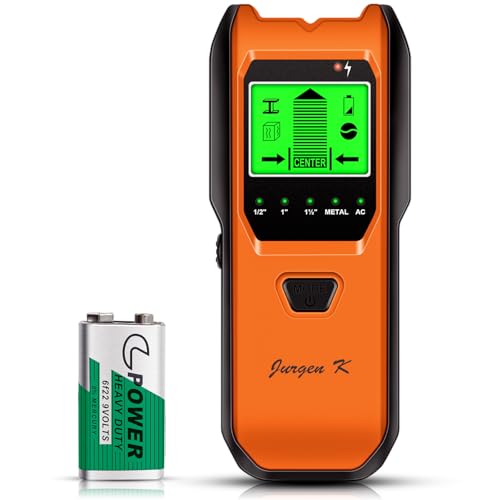
- Five modes cover studs, metal, AC wires, and pipes
- Offers multiple stud depths up to 1.5 inches
- Backlit LCD shows material and detected position
Best For: DIYers needing versatile detection for varied indoor projects
Most Versatile – Franklin Sensors ProSensor M210
For shoppers comparing stud finders, the Franklin Sensors ProSensor M210 is a feature-rich option for routine drywall projects. Its 13 sensors display the full width of wood or metal studs, while deep scanning and live-wire detection add practical versatility.
Best For: DIYers who want full-width stud visibility, deep scanning, and added wall-safety features.
Pros:
- Thirteen sensors are designed for accurate detection and show stud width and centers.
- No calibration is required; scanning can begin anywhere, including over a stud.
- Detects wood and metal studs up to 1.7 inches deep and includes live-wire detection.
- Built-in bubble level and pencil caddy add convenience.
Cons:
- Requires two AA batteries, which are not included.
- Its 1.7-inch sensing depth is less than the ProSensor MAX.
The M210 is a strong all-around choice when you want more information than a basic stud locator provides. Its full-width LED display and no-calibration operation make it especially practical for drilling and mounting tasks.
Simplest Option – Original StudBuddy Magnetic Stud Finder
If you prefer a straightforward approach, the Original StudBuddy is one of the simplest stud finders for drywall. Its powerful neodymium magnets locate the screws or nails securing drywall to wood or metal studs, with no batteries, calibration, or moving parts.
Best For: Drywall users who want a compact, battery-free magnetic stud locator.
Pros:
- Powerful magnets identify screw and nail heads associated with studs.
- Requires no batteries, calibration, or moving parts.
- Lightweight design weighs 1.6 ounces and is made in the USA.
Cons:
- It locates fasteners rather than displaying the full width or center of a stud.
- Not intended for lath-and-plaster walls.
The StudBuddy is a dependable minimalist pick for standard drywall construction. Choose it when simplicity and zero battery maintenance matter more than deep scanning or electronic detection features.
Deepest Scanner – Franklin Sensors ProSensor MAX
Among these stud finders, the Franklin Sensors ProSensor MAX is built for challenging walls and deeper scans. Its 13 larger sensors can detect through up to 2.5 inches of layered or dense material, including plaster, plywood, MDF, OSB, and large tile.
Best For: Renovation projects involving thick walls, multiple layers, or dense wall coverings.
Pros:
- Up to 2.5 inches of detection depth supports scanning through tough materials.
- Thirteen sensors display full stud width, single or double studs, and centers.
- No calibration is required, and scanning can start anywhere.
- Two detection modes support standard and deep scanning.
Cons:
- Its extra-large design weighs 1.1 pounds, making it heavier than compact options.
- Battery power is required.
The ProSensor MAX is the specialized choice for walls that defeat shallow scanners. Its deep-scan mode and larger sensor array make it well suited to renovation work where ordinary drywall detection may not be enough.
Compact Electronic Pick – DEWALT DW0100 Stud Finder
The DEWALT DW0100 is a compact electronic choice for locating wood and metal framing studs. It combines center-find technology, directional LED arrows, audible alerts, and constant auto-calibration for efficient scanning through up to 3/4 inch of material.
Best For: Users who want a slim electronic stud finder with visual, audible, and safety alerts.
Pros:
- Center-find technology helps identify stud centers.
- Detects wood and metal studs to a depth of 3/4 inch.
- Includes AC and live-wire detection, auto-calibration, and a center-marking channel.
- AAA batteries are included, with LED arrows and an audible alert for guidance.
Cons:
- It is not designed for concrete, masonry, plaster, carpeting, foil-faced materials, metallic surfaces, or ceramic tile.
- Its 3/4-inch detection depth is shallower than the Franklin Sensors models.
- It does not locate non-ferrous or plastic objects such as pipes.
The DW0100 makes sense for common, straightforward wall-scanning tasks where compact handling and clear alerts are priorities. Check the wall-material limitations before relying on it for specialized surfaces.
Reliable Edge Scanning – Zircon StudSensor A100
For DIYers comparing stud finders, the Zircon StudSensor A100 offers straightforward edge detection for wood and metal studs. Its StudScan and DeepScan modes, marking aids, and live-wire alerts make it useful for common wall-mounting projects.
Best For: Hanging shelves, mirrors, cabinets, and TVs on standard or thicker walls.
Pros:
- Detects wood and metal stud edges up to 3/4 inch in StudScan mode.
- DeepScan mode reaches up to 1 1/2 inches.
- WireWarning Detection alerts you to hot, unshielded wires up to 2 inches deep.
- LCD display, audio tone, SpotLite Pointer, and V marker groove assist with marking.
Cons:
- Requires careful calibration before each scan.
- Uses a 9V alkaline battery, which is not included in the supplied notes.
The A100 is a practical choice when you want basic stud-edge scanning plus live-wire awareness. Its results depend on holding the scanner flat and moving slowly after calibration.
Fast Full-Width Detection – Franklin Sensors ProSensor M90
The Franklin Sensors ProSensor M90 is one of the more convenient stud finders for users who want to scan without a calibration step. Its nine sensors display the full width of wood or metal studs and can scan up to 1.5 inches deep.
Best For: DIYers who want full-width stud visualization and simple, no-calibration scanning.
Pros:
- Nine sensors are designed to provide accurate detection.
- No calibration is required; press and hold the button to scan.
- LEDs show the full width of studs, including double studs, with a green center indicator.
- Deep scan is always on and detects wood and metal studs up to 1.5 inches deep.
Cons:
- Requires two AAA batteries, which are not included.
- Not compatible with rechargeable batteries.
The M90 stands out for its simple operation and full-width LED display. It is a strong fit for users who prefer immediate scanning over a multi-mode interface.
Versatile Wall Scanning – Zircon MultiScanner A200
Among stud finders, the Zircon MultiScanner A200 is suited to projects that require more than basic stud-edge detection. It scans for wood and metal studs, metal objects, and live wires, while its display and SpotLite Pointer help guide marking before drilling.
Best For: Mounting projects that involve wood or metal studs and checking for metal or live wires before drilling.
Pros:
- StudScan identifies stud edges and centers up to 3/4 inch deep.
- DeepScan reaches up to 1 1/2 inches, and Metal Scan locates metal behind walls.
- Detects wood and metal studs and indicates stud direction.
- WireWarning Detection, LCD display, audio tone, and SpotLite Pointer add scanning guidance.
Cons:
- Requires correct calibration before scanning.
- Uses a 9V alkaline battery, which is not included in the supplied notes.
The A200 is the most versatile option in this group for users who want dedicated metal scanning alongside stud and live-wire detection. Its multiple modes provide flexibility, but careful calibration remains important.
Top Calibration-Free Pick – Franklin Sensors ProSensor M150
For shoppers comparing stud finders, the Franklin Sensors ProSensor M150 stands out for its nine-sensor design and calibration-free operation. It scans up to 1.5 inches deep, detects wood and metal studs, displays the full stud width, and includes live-wire detection.
Best For: DIYers who want straightforward, full-width stud detection without a calibration step.
Pros:
- Nine sensors are designed to improve accuracy over basic one- or two-sensor models.
- No calibration is required; press and hold the button to scan.
- LEDs show stud width, double studs, and the center.
- Detects wood and metal studs up to 1.5 inches deep and warns about live wires.
Cons:
- Two AAA batteries are required and are not included.
- It is not compatible with rechargeable batteries.
The M150 is a practical choice when ease of use and clear stud-center indications matter more than extra functions such as a built-in laser level.
Best 2-in-1 Layout Tool – PREXISO Stud Finder with Laser Level
The PREXISO combines a rechargeable stud finder with a manual-leveling cross-line laser, making it one of the more versatile stud finders for indoor projects. It detects wood and metal studs through drywall, warns about AC wires, and projects a laser line when a stud edge is found.
Best For: DIY decorators and installers who need stud detection plus visual alignment for shelves, pictures, and similar projects.
Pros:
- Combines rechargeable stud detection with a cross-line laser level.
- Detects wood and metal studs up to 3/4 inch deep and AC wires up to 1-1/2 inches.
- Automatically projects a vertical laser line when a stud edge is detected.
- Includes a rotating wall mount, pins, adhesive strips, storage bag, and charging cable.
Cons:
- Calibration is required for the stud-finder function.
- The laser is manual-leveling rather than self-leveling.
- It is not designed for lath-and-plaster walls and works best on drywall and wood walls.
This PREXISO model offers useful marking and alignment features, but its manual leveling and surface limitations should be considered before purchase.
Best Multi-Mode Scanner – Jurgen K 5-in-1 Wall Scanner
Among stud finders with broader material coverage, this Jurgen K wall scanner offers five detection modes for studs, metal, AC wires, and pipes. Its backlit LCD shows the detected material and position, while audio alerts and center-and-edge readings help guide installations.
Best For: Homeowners and DIYers who want multiple scan depths and detection modes for varied indoor tasks.
Pros:
- Five modes cover 1/2-inch, 1-inch, and 1.5-inch stud scans, plus metal and AC detection.
- Can identify stud and wire edges and centers.
- Backlit LCD, continuous beeping, and a low-power indicator provide useful feedback.
- Ergonomic non-slip grip supports comfortable scanning.
Cons:
- Calibration is required before use.
- The included 9V battery will eventually need replacement.
- Results can vary by surface, so the device should be calibrated on the wall before scanning.
With its wide range of scan modes and readable display, this scanner is well suited to projects where detecting more than just standard wall studs is important.
How We Picked These Stud Finders
We selected models that cover the main ways homeowners and contractors locate wall framing: magnetic detection, electronic multi-sensor scanning, metal detection, live-wire warnings, and laser leveling. We also considered detection depth, ease of use, power requirements, display or alert clarity, and suitability for common drywall projects.
No stud finder is foolproof. Wall thickness, moisture, textured surfaces, pipes, wiring, and irregular framing can affect readings. The most useful tool is one that matches your wall type and gives clear, repeatable results when used according to its instructions.
Quick Comparison
| Type | Best For | Main Advantage | Common Limitation |
|---|---|---|---|
| Magnetic | Basic drywall projects | No batteries and simple operation | Finds fasteners rather than directly sensing the entire stud |
| Multi-sensor electronic | General home improvement | Can scan wider areas and locate stud edges or centers | Requires calibration and batteries or charging |
| Metal and live-wire scanner | Renovation and drilling safety | Helps identify framing materials and electrical hazards | Readings can be affected by dense or uneven walls |
| Laser-equipped scanner | Layout and installation work | Combines locating with alignment | More features and setup than a basic finder |
Key Buying Factors for Stud Finders
Detection Depth and Sensor Coverage
Choose a deeper-scanning model when working through thicker drywall, paneling, tile, or layered surfaces. Wider sensor arrays can make it faster to identify a stud’s center, while simpler tools may require more passes.
Live-Wire and Metal Detection
Live-wire alerts are valuable before drilling, but they should be treated as a warning system rather than a guarantee of safety. Metal detection can help locate steel framing, screws, nails, pipes, or other objects, so interpret results in context.
Controls, Calibration, and Alerts
LED arrows, audio alarms, LCD screens, and center-finding indicators make readings easier to understand. Automatic calibration is convenient, but proper placement and steady movement still matter. Avoid scanning over wet surfaces or cluttered areas when possible.
Power and Portability
Battery-free magnetic finders are compact and always ready, while electronic models offer more information at the cost of batteries or charging. For frequent work, consider battery life, grip comfort, and whether the device can be stored without losing calibration.
Who Should Buy Which Stud Finders?
Choose a magnetic option for occasional picture hanging, light shelves, and simple drywall work when you want the lowest-maintenance solution. A basic electronic scanner is a better all-purpose choice for homeowners tackling multiple projects. Select a deeper multi-sensor model for thicker walls or faster center detection, and choose a metal-and-wire scanner when drilling safety is a priority. If you also need straight reference lines for cabinets, tile, shelving, or fixtures, a model with a built-in laser level can replace a separate layout tool.
Whichever of these Stud Finders you choose, confirm the reading with multiple passes and measure from nearby corners, outlets, or known framing before making a permanent hole.