The best pipe cutters make clean, square cuts with less effort than a hacksaw and leave tubing ready for fitting or soldering. This roundup covers compact close-quarters models, heavy-duty tubing cutters, ratcheting plastic cutters, and a cordless option.
Use the comparison and buying advice below to match cutting capacity, material compatibility, access, and operating style to your plumbing or DIY project.
Best 10 Pipe Cutters Picks for 2026
Best Professional Tubing Cutter
RIDGID Model 152 Quick-Acting Cutter

- Cuts tubing from 1/4 to 2-5/8 inches
- Quick-acting design with ergonomic X-Cel knob
- Includes fold-away reamer and tool-free wheel changes
Best For: Professional plumbing, HVAC, and broad-capacity tubing work
Best Ratcheting PVC Cutter
LIBRATON 2-1/2-Inch Ratchet Cutter

- Cuts PVC, PEX, PE, rubber hose, and other plastics
- Ratcheting drive reduces hand effort
- Tool-free quick-change blade system
Best For: Large plastic pipe and hose cutting
Best Close-Quarters Cutter
RIDGID Model 101 Tubing Cutter

- Designed for tight spaces and small tubing
- Cuts copper, aluminum, brass, and plastic
- Includes a spare cutter wheel
Best For: Small-diameter tubing repairs in confined areas
Best Complete Cutting Kit
TOLESA Heavy-Duty Pipe Cutter Set
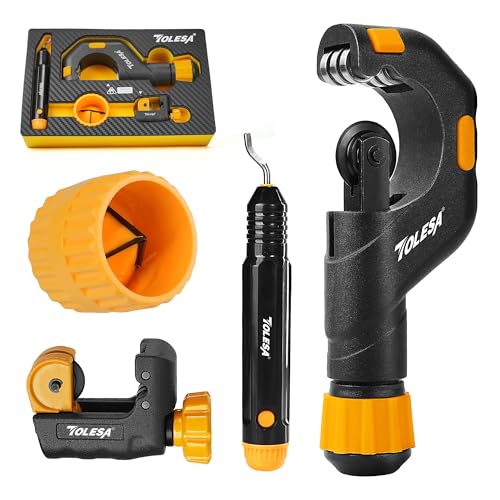
- Includes heavy-duty and mini pipe cutters
- Adds deburring and reaming tools
- Covers pipe sizes from 1/8 to 2 inches
Best For: DIY and trade work requiring cutting plus edge finishing
Best Overall Metal Tubing Cutter

- Cuts 1/8- to 1-1/8-inch metal tubing
- Enclosed feed screw helps prevent jams
- Includes reamer and spare cutter wheel
Best For: Small-diameter copper, brass, and aluminum tubing
Best for PVC and PEX

- Cuts PVC, CPVC, and PEX
- Supports up to 2-3/8-inch outside diameter
- Ratcheting blade with soft-molded handles
Best For: Plastic pipe work in plumbing and electrical projects
Best for Comfort

- Compact design for restricted access
- AUTOFEED advances the cutter
- Cuts 1/4- to 1-1/8-inch metal tubing
Best For: Professional close-quarters tubing work
Best Large-Capacity PVC Cutter

- Cuts plastic pipes up to 2-1/2 inches
- Ratchet action reduces cutting effort
- SK5 blade with lightweight aluminum-alloy body
Best For: Large PVC, PEX, and plastic plumbing cuts
Best Powered Copper Cutter

- Automatically adjusts from 3/8 to 1 inch
- 500 RPM motor supports fast cutting
- Works in low-clearance spaces near walls
Best For: Copper tubing and M12 tool-platform users
Best Tube Cutter Set
Heavy-Duty Cutter and Deburring Kit

- Covers tubing from 1/8 to 2 inches
- Includes mini and large cutters
- Adds a high-speed-steel deburring tool
Best For: Mixed-size copper, aluminum, and PVC tubing
Best Professional Tubing Cutter – RIDGID Model 152 Quick-Acting Cutter
For demanding plumbing, HVAC, electrical, and DIY work, this RIDGID tubing cutter gives pipe cutters a broad 1/4- to 2-5/8-inch capacity. Its quick-acting design and ergonomic X-Cel knob help speed adjustments while maintaining a durable, hand-powered build.
Best For: Professionals and serious DIY users cutting a wide range of metal tubing.
Pros:
- Broad 1/4- to 2-5/8-inch cutting capacity
- Quick-acting mechanism with smooth thrust-bearing slide assemblies
- Fold-away reamer helps clean tubing for better connections
- Tool-free cutter-wheel changes with ball-detent retention
Cons:
- Heavier and larger than compact close-quarters cutters
- Designed for tubing rather than primarily plastic pipe
This is a strong all-around choice when capacity, durability, and efficient adjustment matter more than minimum size or weight. The lifetime warranty against material and workmanship defects adds confidence for regular use.
Best Ratcheting PVC Cutter – LIBRATON 2-1/2-Inch Ratchet Cutter
This LIBRATON ratcheting cutter is among the more versatile pipe cutters for plastic applications, handling PVC, CPVC, PP-R, PEX, PE, and rubber hose up to 2-1/2 inches. Its ratchet drive, spring-loaded handle, and locking mechanism are geared toward efficient, controlled cuts.
Best For: Plumbers, electricians, mechanics, and home users cutting large plastic pipe and hose.
Pros:
- Handles plastic pipe and hose up to 2-1/2 inches or 63 mm
- Ratchet design helps reduce cutting effort
- SK5 Teflon-coated blade and durable aluminum-alloy body
- Quick-change blade system requires no tools
Cons:
- Replacement blade is not included
- Blade life varies with the pipe material
- Thin pipe requires careful technique to avoid breaking
Choose this model if you mainly cut plastic materials and want leverage over a simple scissor-style cutter. Correct pipe positioning is important for straight cuts, and the included safety lock helps secure the tool during storage.
Best Close-Quarters Cutter – RIDGID Model 101 Tubing Cutter
When access is limited, this compact RIDGID is one of the most useful pipe cutters for small-diameter tubing. The close-quarters design fits tight spaces, while its 1/4- to 1-1/8-inch range covers common copper, aluminum, brass, and plastic tubing tasks.
Best For: Plumbers and DIY users making small tubing cuts in confined areas.
Pros:
- Compact design for tight spaces
- Works with hard and soft copper, aluminum, brass, and plastic
- Knurled feed screw provides control over cutting pressure
- Includes a spare cutter wheel
Cons:
- Limited to tubing up to 1-1/8 inches
- Not suited to larger pipe-cutting jobs
Its small footprint and light 7.8-ounce weight make it a practical addition to a tool kit where a full-size cutter cannot maneuver. The narrower capacity is the tradeoff for that tight-access capability.
Best Complete Cutting Kit – TOLESA Heavy-Duty Pipe Cutter Set
This TOLESA set gives pipe cutters a flexible four-piece setup for metal and copper pipe work. It combines a heavy-duty cutter, mini cutter, deburring tool, and pipe reamer, making it useful when one tool needs to handle standard cuts, tight spaces, and finishing tasks.
Best For: DIYers and tradespeople who want cutting, deburring, and reaming tools in one kit.
Pros:
- Includes heavy-duty 3/16- to 2-inch and mini 1/8- to 3/4-inch cutters
- Six ball-bearing rollers help stabilize the pipe during cutting
- Combines cutting, deburring, and reaming functions
- Aluminum-alloy construction balances durability and weight
Cons:
- Requires manual tightening and rotation for each cut
- Set includes multiple pieces that require storage
This is the most versatile package of the four when you value accessories and coverage over having a single specialized cutter. The mini tool is especially useful for confined work, while the included finishing tools help prepare edges after cutting.
Best Overall Metal Tubing Cutter – RIDGID Model 150
RIDGID 31622 Model 150 Constant Swing Tubing Cutter, 1/8-Inch to 1-1/8-Inch Tube Cutter
Check Price On AmazonFor copper, brass, and aluminum tubing, the RIDGID Model 150 is a versatile pipe cutter with a 1/8- to 1-1/8-inch capacity. Its enclosed feed screw, grooved rollers, and ergonomic X-CEL knob are designed to make hand cutting smoother and more controlled.
Best For: DIYers and professionals cutting small-diameter metal tubing and thin-wall conduit.
Pros:
- Handles copper, brass, aluminum, and thin-wall conduit from 1/8 to 1-1/8 inches.
- Enclosed feed screw helps resist clogging and jamming.
- Includes a fold-away reamer, spare cutter wheel, and tool-free wheel changes.
- Large X-CEL knob offers a more secure, comfortable grip.
Cons:
- Its capacity is limited to tubing up to 1-1/8 inches.
- Designed for tubing rather than larger plastic pipe.
The Model 150 is a strong all-around choice when you need a compact, hand-powered cutter for metal tubing. Its reamer and quick-change wheel add convenience for recurring cutting tasks.
Best for PVC and PEX – Klein Tools 50080
The Klein Tools 50080 is a ratcheting pipe cutter built for PVC, CPVC, and PEX. With a cutting capacity up to 2 inches inside diameter and 2-3/8 inches outside diameter, it suits common plumbing and electrical projects.
Best For: Homeowners, handymen, plumbers, and electricians cutting plastic pipe.
Pros:
- Cuts Schedule 40 and Schedule 80 PVC, CPVC, and PEX.
- Handles pipe up to 2-inch inside diameter and 2-3/8-inch outside diameter.
- Ratcheting action supports controlled cutting.
- Soft-molded handles provide a comfortable, secure grip.
Cons:
- Not intended for the metal tubing applications covered by the RIDGID cutters.
- At 1.25 pounds, it is heavier than a compact tubing cutter.
Choose the 50080 when your pipe-cutting work centers on plastic plumbing materials. Its optimized jaw and ratcheting blade make it a practical option for a range of PVC, CPVC, and PEX sizes.
Best for Comfort – RIDGID Model 118
The RIDGID Model 118 is a compact 2-in-1 pipe cutter with AUTOFEED for tight working areas. It cuts 1/4- to 1-1/8-inch copper, brass, and aluminum tubing, making it a focused choice when access is limited.
Best For: Professional users cutting small metal tubing in close quarters.
Pros:
- Compact design is suited to close-quarters work.
- AUTOFEED helps advance the cutter during use.
- Handles 1/4- to 1-1/8-inch copper, brass, and aluminum tubing.
- Listed with an ergonomic grip and professional-specific use.
Cons:
- Its 1-1/8-inch cutting width limits it to smaller tubing.
- It is specialized for metal tubing rather than PVC or larger pipe.
The Model 118 stands out for installation and repair tasks where a full-size cutter is awkward to position. Its compact format and AUTOFEED feature make it particularly useful for professional close-quarters cutting.
Best Large-Capacity PVC Cutter – Ratchet PVC Pipe Cutter
For cutting larger plastic plumbing materials, this ratchet PVC pipe cutter offers a practical alternative to saws and heavy manual tools. Its SK5 blade and ratcheting action are designed for smooth, controlled cuts through pipes up to 2-1/2 inches outside diameter.
Best For: DIYers, plumbers, and maintenance work involving PVC, PEX, PPR, PE, rubber pipes, and plastic hoses.
Pros:
- Handles pipes up to 2-1/2 inches in outside diameter.
- Ratchet mechanism helps reduce hand and wrist strain.
- SK5 blade and aluminum-alloy body are designed for durability without excessive weight.
- Pointed blade angle helps hold the pipe during cutting.
Cons:
- Best results require careful pipe alignment and a tightened blade.
- Designed for plastic and similar materials rather than copper tubing.
This is a strong choice among pipe cutters when you need broad plastic-pipe capacity and easier cutting by hand. Follow the alignment guidance for cleaner, straighter cuts.
Best Powered Copper Cutter – Milwaukee M12 Cordless Cutter
This cordless Milwaukee pipe cutter is built for fast copper-tubing work in plumbing applications. It automatically adjusts to 3/8- to 1-inch Type K, L, and M copper pipe and uses an M12 battery-powered motor for cutting in tight spaces.
Best For: Plumbers and tradespeople who regularly cut copper tubing and already use Milwaukee M12 batteries.
Pros:
- Automatic adjustment covers 3/8- to 1-inch copper pipe diameters.
- 500 RPM motor is designed to work faster than standard hand cutters or saws.
- Low-clearance design works with piping as close as 1-1/2 inches from a wall.
- Sealed head helps protect the motor from water exposure.
Cons:
- Battery and charger are not included.
- Designed for copper tubing rather than broad plastic-pipe applications.
- Requires a compatible Milwaukee M12 REDLITHIUM battery.
Among powered pipe cutters, this model stands out for speed and confined-space access. It makes the most sense for users invested in the M12 platform, since the tool is sold separately from the battery.
Best Tube Cutter Set – Heavy-Duty Cutter and Deburring Kit
This tube cutter set gives you two size ranges plus a deburring tool, making it a flexible option when one cutter is not enough. The kit covers tubing from 1/8 to 2 inches outside diameter and is intended for copper, aluminum, and PVC pipes.
Best For: Professionals and serious DIY users who want multiple tube-cutting capacities with a dedicated post-cut deburring tool.
Pros:
- Includes a mini cutter for 1/8- to 7/8-inch tubing and a large cutter for 3/16- to 2-inch tubing.
- Six independent bearings support smooth, precise cutting.
- Heat-treated alloy-steel construction is designed for long-term durability.
- High-speed-steel deburring tool helps refine cut edges.
Cons:
- Requires manual operation rather than powered cutting.
- The overlapping size ranges may be more equipment than occasional users need.
This is one of the more versatile pipe cutters for mixed-size projects because it combines broad capacity with edge finishing. Choose it when clean, deburred tube ends matter as much as the initial cut.
How We Picked These Pipe Cutters
We selected tools across the main pipe-cutting categories: manual tubing cutters for copper, brass, and aluminum; ratcheting cutters for PVC, PEX, and other plastic pipe; compact models for restricted spaces; and powered tools for faster repetitive work. We compared stated cutting ranges, cutter design, adjustment method, portability, and useful extras such as deburring features or included accessories.
Capacity matters, but it is not the only consideration. A cutter that handles a large diameter may be less convenient than a compact model when working behind cabinets or between existing fittings. Likewise, a plastic-pipe ratchet cutter is generally a better choice for PVC than a wheel-style metal tubing cutter.
Quick Comparison
| Best For | Recommended Type | What to Look For |
|---|---|---|
| Copper and metal tubing | Wheel-style tubing cutter | Correct diameter range, smooth adjustment, spare cutting wheel |
| PVC, PEX, and plastic hose | Ratcheting pipe cutter | Sharp replaceable blade, strong jaw, suitable capacity |
| Tight access | Close-quarters cutter | Compact body and minimal handle swing |
| Frequent repetitive cuts | Cordless cutter | Battery compatibility, speed, and control |
| Mixed projects | Multi-tool or cutter set | Broad range and included deburring tool |
Key Buying Factors for Pipe Cutters
Material Compatibility
Choose a wheel cutter designed for the metal you are cutting, or a ratcheting blade made for plastic pipe. Do not assume one tool safely handles every material. PVC and PEX cutters are not substitutes for copper-tubing cutters, while metal cutting wheels can damage or deform plastic.
Cutting Capacity
Check the stated outside-diameter range, not just the nominal pipe size. A cutter should accommodate your largest pipe while still closing securely around your smallest tube. Leaving some capacity in reserve can also make future projects easier.
Access and Ergonomics
For exposed pipe on a workbench, a full-size handle is often easiest to turn. In confined plumbing spaces, a close-quarters design with a compact profile is more useful. Ratcheting handles reduce the clearance needed for plastic cuts, while powered models can reduce hand fatigue during repeated work.
Cut Quality and Maintenance
A clean, square cut helps fittings seat correctly. Look for a rigid frame, a sharp blade or wheel, and controlled adjustment. Deburring is especially important after cutting metal tubing, so an integrated or included reamer can save time. Keep cutting wheels and blades clean, and replace them when cuts become rough or require excessive force.
Who Should Buy Which Pipe Cutters?
Homeowners and occasional DIY users: A straightforward ratcheting PVC cutter or versatile cutter set is usually the most convenient choice for common repairs.
Plumbers working with copper: Choose a reliable wheel-style tubing cutter with a range suited to your usual tube sizes. A compact backup is valuable for repairs in cramped spaces.
Professionals handling tight installations: A close-quarters cutter can save time where a standard handle cannot swing freely.
Users making many repeated cuts: Consider a cordless cutter if speed and reduced wrist effort justify the battery and tool cost. For occasional work, a manual cutter is typically simpler, quieter, and less expensive.